Overview
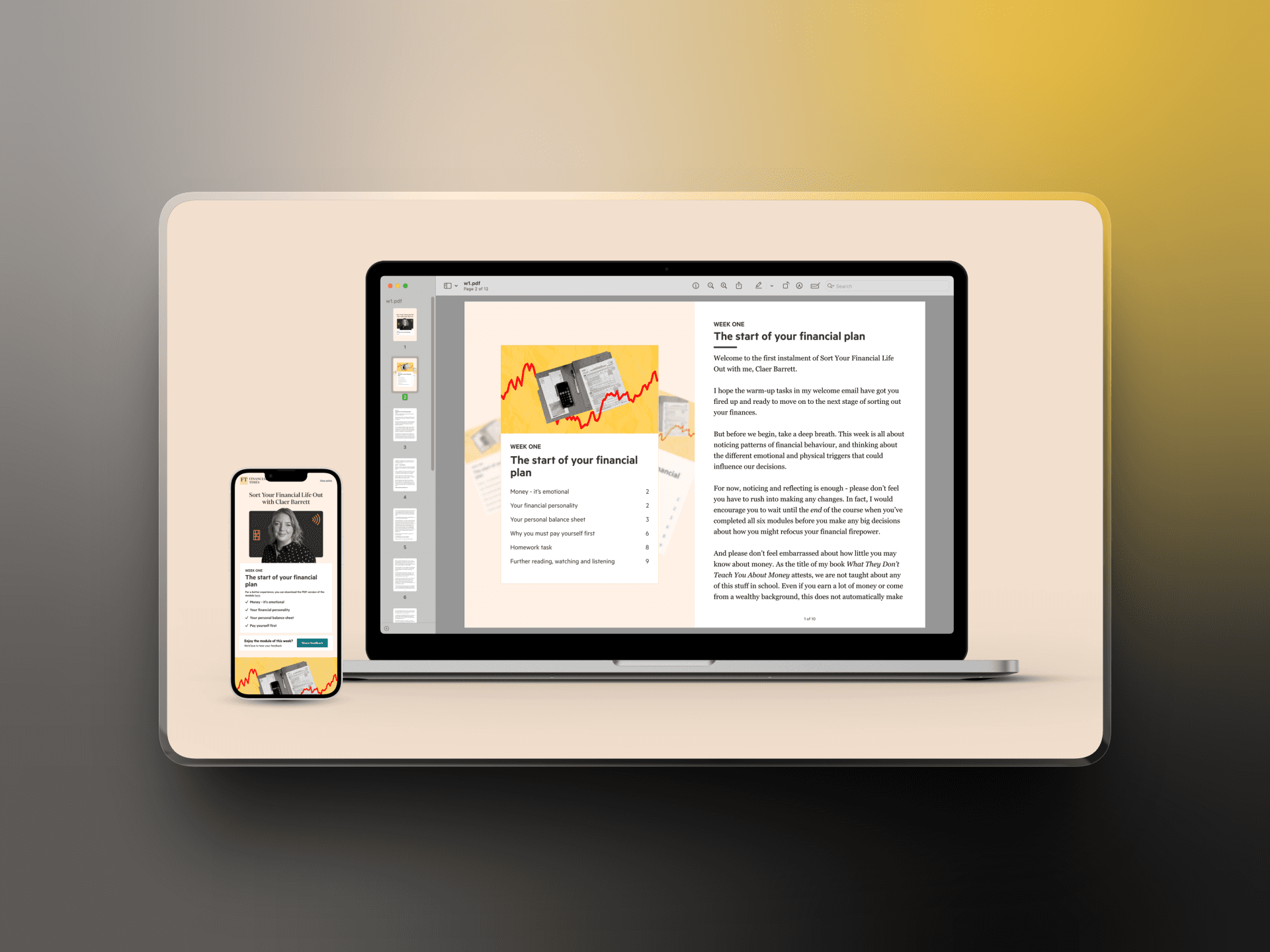
At the start of 2024, the Financial Times launched a six-part personal finance email course authored by Personal Finance Editor Claer Barrett.
The course was designed to help people feel more confident and in control of their finances by breaking down complex topics into simple, practical steps. Delivered as a weekly email series, it covered areas such as budgeting, tax, investing, and managing money within relationships.
This was a new type of product for the FT.
Existing subscribers could access the course at no additional cost, while non-subscribers were offered the full course alongside eight weeks of FT access for a one-time fee of £19.
The strategic goal was twofold: create meaningful added value for existing subscribers while testing whether structured, editorial-led content could act as a new acquisition and retention channel outside the traditional subscription model.
I led the UX strategy and end-to-end journey design across acquisition, onboarding, payment, activation, and the eight-week learning experience.
Impact
Over 34,000 users signed up within the first six weeks, exceeding initial forecasts
Pre-registration to paid conversion reached 27%
Average email open rates hit 52% across the full sequence, significantly outperforming standard lifecycle benchmarks
More than 2,000 users converted into FT subscribers after the course
The framework has since been adopted as a model for future newsletter-led acquisition products, with two follow-on concepts already in development
This project became an important proof point for how editorial products could drive both engagement and commercial outcomes.
My Role
I led the product design strategy across the full user journey.
This included:
defining acquisition and onboarding flows for multiple user types
designing adaptive journeys based on subscription status
simplifying payment and activation flows
shaping the learning experience across email and downloadable content
aligning design decisions with editorial, marketing, engineering, and commercial teams
measuring funnel performance and identifying optimisation opportunities
A large part of the work involved translating editorial content into a scalable product experience that felt supportive, accessible, and commercially effective.
The Challenges
The core challenge was designing a product that served very different audiences without creating friction.
We needed to support three distinct user groups:
existing FT subscribers
registered users
anonymous visitors
Each group had different expectations around trust, effort, and value.
Subscribers needed near-zero friction.
New users needed reassurance, clarity, and a low-anxiety route into payment and activation.
At the same time, the product had to preserve the FT’s authority while feeling significantly more approachable than traditional financial journalism.
Research showed that many users found money management intimidating and often felt existing financial content was too complex or expert-led.
This meant the product needed to feel educational and empowering rather than transactional.
Alongside this, we had to work within multiple technical systems including Bloomreach, FT account infrastructure, and Zuora, each introducing platform constraints that affected journey design.
Research and Discovery
I led the early discovery phase to understand user confidence levels, motivations, and conversion barriers.
User research
Through interviews and surveys, we found a strong emotional theme:
users wanted help, but felt intimidated by financial content.
Many described wanting simple, practical steps rather than expert commentary.
This insight became central to the product direction.
The experience needed to reduce anxiety from the very first interaction.
Users also responded strongly to the involvement of Claer Barrett, whose voice added credibility and warmth.
This trust factor became an important conversion driver.
Behavioural insights
We also reviewed existing FT analytics and identified meaningful drop-off in previous registration and payment journeys.
The biggest opportunities were:
reducing steps to payment
clarifying the value proposition earlier
removing ambiguity around what users would receive
improving confidence at the point of purchase
These insights directly shaped the landing page hierarchy and onboarding flow.
Strategic design thinking
Rather than treating this as a newsletter sign-up flow, I approached it as a lifecycle product.
The user journey extended far beyond conversion.
I mapped the full experience from:
discovery → sign-up → payment → weekly engagement → FT subscription conversion
This allowed us to design for long-term engagement, not just initial acquisition.
For senior product roles, this type of thinking is particularly important because it demonstrates ownership of the full funnel.
Design approach
The experience was built around two key landing journeys.
A pre-launch registration page was designed to capture early interest and build momentum ahead of release.
Once live, this transitioned into a sign-up and payment journey that dynamically adapted based on user state.
Key design decisions included:
simplified landing page hierarchy focused on clarity and trust
strong expert-led credibility through Claer’s presence
transparent pricing and access messaging
adaptive CTA logic by user segment
warm, non-intimidating microcopy
clear expectation setting for the six-week structure
A major focus was reducing perceived effort.
The structured six-part format with a clear end point performed strongly because it felt achievable and finite.
This was a key behavioural design decision.
Learning experience design
The product experience extended beyond acquisition into sustained weekly engagement.
Each email was designed as a lightweight learning module.
Content focused on:
concise practical advice
clear next steps
optional worksheets
reflective exercises
progress reinforcement
The tone was intentionally warm, encouraging, and free from financial jargon.
This helped reduce drop-off and supported the strong open rates across the eight-week journey.
Supporting downloadable worksheets extended the experience offline and gave the product more perceived value.
Cross-functional leadership
This project required close collaboration across multiple teams.
I worked closely with:
editorial on content structure and tone
marketing on acquisition messaging
engineering on system constraints and payment flows
CRM teams on lifecycle email delivery
commercial stakeholders on conversion goals
A key part of my role was aligning editorial integrity with commercial performance without compromising trust.
Outcome
The product significantly outperformed expectations.
Within six weeks:
34,000+ users enrolled
conversion rates exceeded forecasts
open rates remained exceptionally strong
over 2,000 users converted into FT subscribers
More importantly, the product established a new acquisition model for the FT.
It proved that structured editorial learning products could successfully drive acquisition, engagement, and subscription conversion outside the traditional news product funnel.
This has since informed multiple future initiatives across the business.
Personal Finance
Financial Times
2025
The Personal Finance Course is a six-part, editorial-led email product from the Financial Times, designed to help readers build confidence in managing their finances through clear, practical weekly guidance, while also serving as a new acquisition and retention pathway beyond the traditional subscription model.
... Seb brought a much needed pair of fresh eyes and delivered beyond our expections.

Bill M.
CEO of ACrew4U

App Onboarding
Financial Times
2025
Overview
Overview
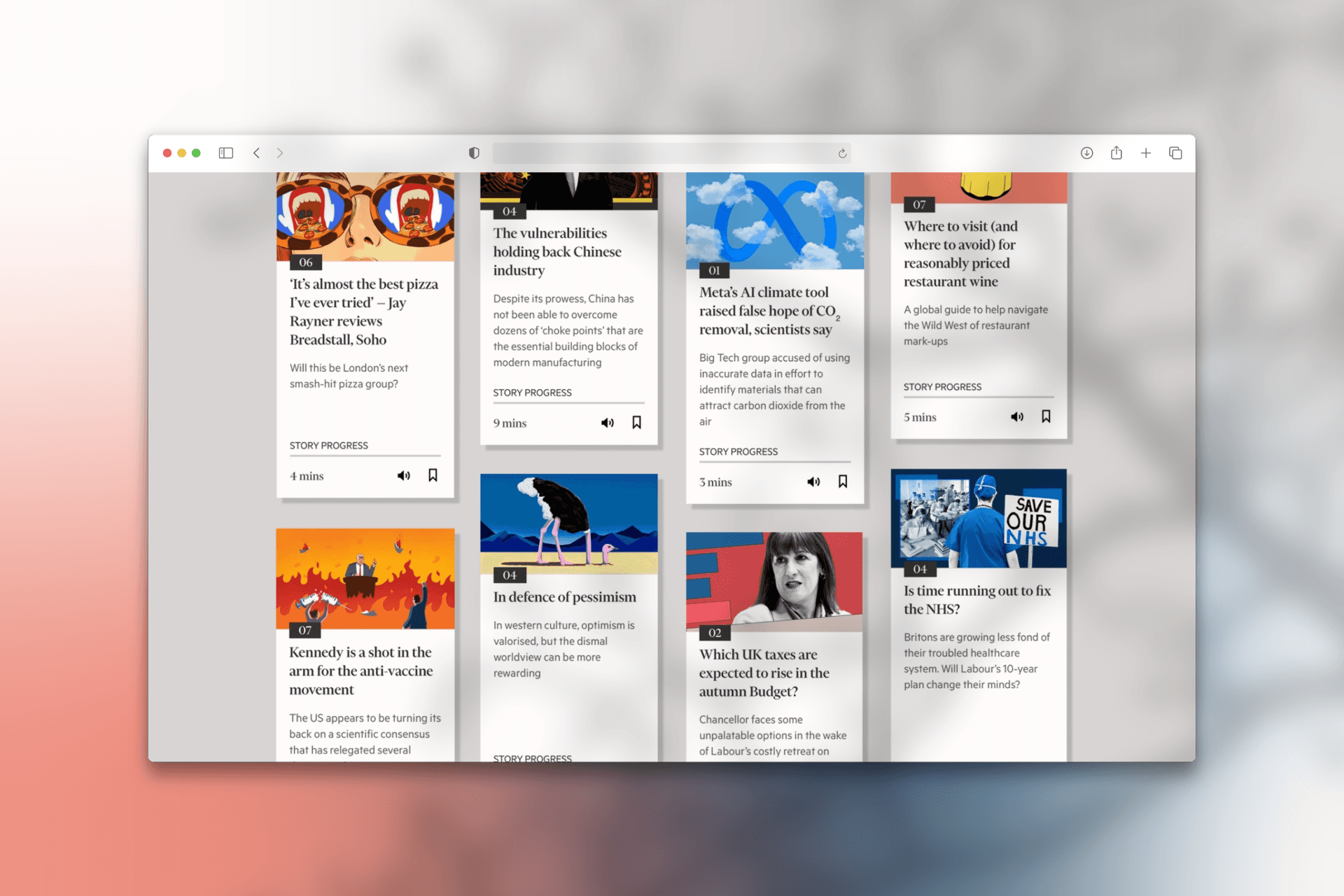
FT Edit is a curated, mobile-first editorial product from the Financial Times, designed to offer a slower, more intentional news experience through a daily selection of eight handpicked articles. In Q2 2025, we began migrating FT Edit into the main FT iOS app, replacing the standalone version as the primary way to access the product.
The goal was to reduce fragmentation, make app discovery easier, and allow users to subscribe directly within the main app. The challenge was to retain FT Edit’s calm, focused feel while integrating it into a much busier and more complex environment. My role was to shape a smooth and thoughtful user journey that worked across different areas of the app and different subscription states, so that no matter how someone entered the FT ecosystem, they could easily find and use FT Edit.
Impact and key results
28% of existing FT Edit standalone app users migrated to the integrated FT app experience within the first four weeks after launch, surpassing the initial expectation of 20%.
Trial activations increased by approximately 15% due to the introduction of preview content and a soft registration flow that lowered entry barriers for new users.
Qualitative feedback gathered from user surveys and support channels indicated strong satisfaction, with many users commenting that the transition felt “seamless” and “unobtrusive,” preserving the editorial tone and reading experience they valued.
My Role
I led the UX strategy for the migration, working closely with product and design teams to map out entry points, streamline transitions between apps, and ensure user flows aligned with subscription logic. This included defining user states, access levels, and content journeys based on whether someone was anonymous, registered, subscribed, or on a trial.I also helped design the migration experience for existing FT Edit users and also helped to support discoverability, purchase flows, and post-migration retention within the main app.
The Challenge
The primary challenge was balancing preservation of FT Edit’s editorial calmness and simplicity with the realities of integration into a more feature-rich app. FT Edit users were highly sensitive to changes in tone, layout, or flow, any disruption risked alienating loyal readers.
Other challenges included:
Supporting multiple user states: Existing subscribers needed seamless migration, new users required gentle onboarding, and FT app subscribers unfamiliar with FT Edit deserved clear, non-intrusive promotion.
Subscription complexity: The migration coincided with launching Apple in-app purchase flows, adding monthly and annual plans that had to align with Apple’s strict policies and billing mechanisms.
Discoverability without confusion: FT Edit had to be prominent enough to attract new users but not so loud as to cannibalise other FT content or overwhelm users.
Continuity: It was vital that the transition felt like a natural evolution rather than a disruptive change.
Research and Discovery
To understand the nuances of FT Edit users and prepare for migration, I undertook a discovery phase:
Behavioural data analysis: Using Amplitude, I analysed in-app behaviour to uncover patterns in engagement and friction points:
Average session length: 4.6 minutes (vs. 3.8 minutes on FT app)
Article completion rate: 61% (vs. 47% benchmark on FT app) These insights highlighted opportunities to reduce friction in trial flows and improve onboarding clarity.
User interviews and surveys: We gathered qualitative feedback from existing FT Edit subscribers through customer care to learn what they valued most about the product, what caused frustration, and their expectations for the migration. Many emphasised the value of simplicity and the uncluttered approach.
Support and feedback logs: I analysed tickets and comments to identify recurring pain points for both apps, seeing where improvements could be made with a new version of the Edit.
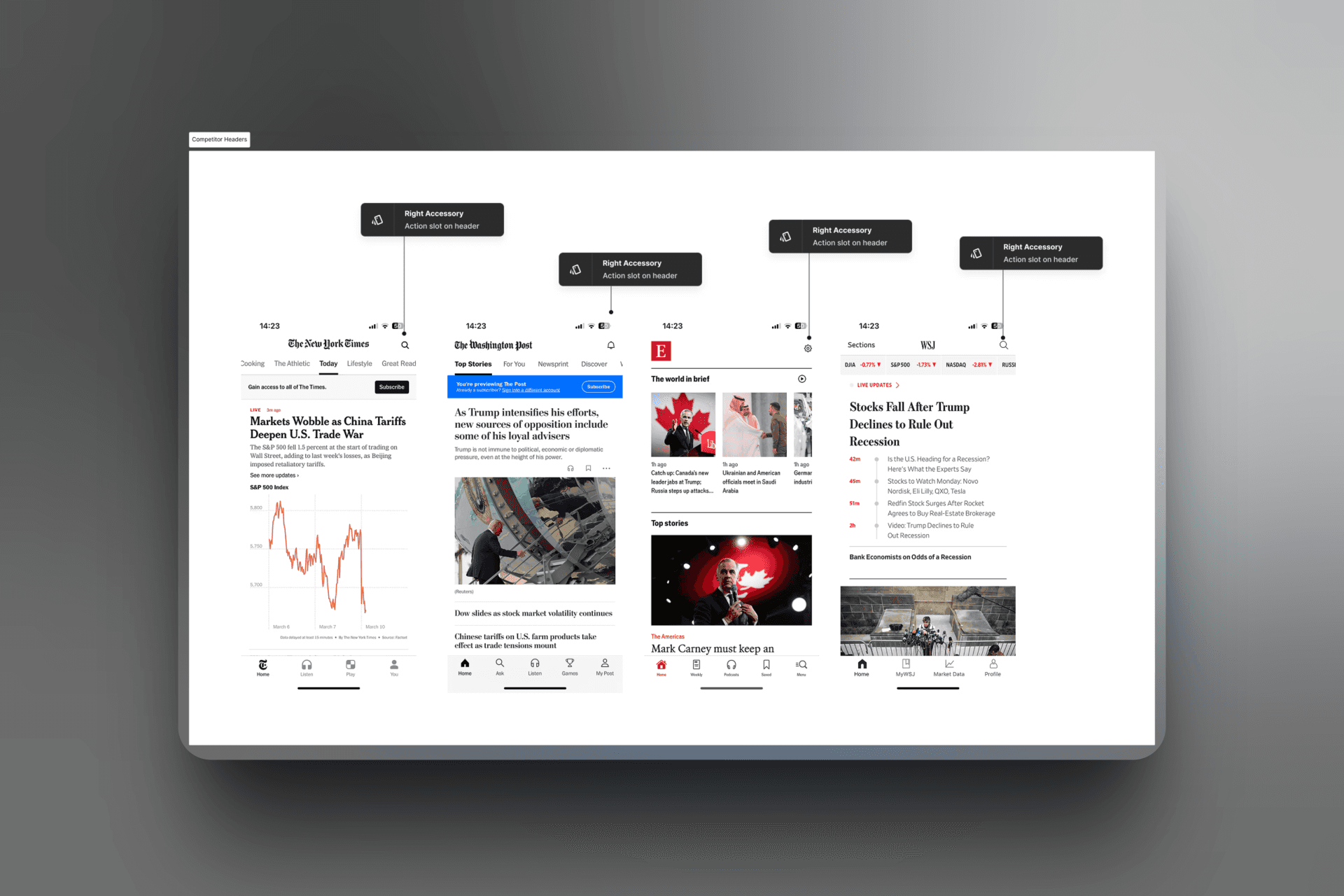
Competitive benchmarking: I studied how similar publishers (The New York Times) had successfully integrated niche products (like NYT Cooking) into their main apps, extracting lessons about navigation, subscription management, and user onboarding. (This gave us lots of ideas to start tesing in the design phase)
Stakeholder workshops: Sessions with product owners, engineers, editorial, and legal teams helped to clarify business goals, technical limitations, and compliance requirements.
The 3.8-minute average session length and 61% article completion rate (both outperforming FT app benchmarks) validated that FT Edit’s compact, curated format was resonating. This reinforced the need to preserve editorial simplicity in the integrated experience, guiding our early navigation designs toward a dedicated, distraction-free content surface within the main FT app.
User Journey Mapping
With research insights in hand, I mapped four primary user journeys.
Existing FT Edit subscribers
Needed an effortless, one-tap migration from the standalone app to the integrated FT app experience.
Expected to find the familiar editorial structure, interaction patterns swipe navigation), and visual tone intact.
Required clear reassurance that no content or features were lost.
Anonymous or registered non-subscribers
Needed a low-friction introduction with preview content access before committing to registration or payment.
The flow needed to encourage trial activation through soft gating like banners, modals, or inline messages rather than aggressive paywalls.
FT app subscribers unfamiliar with FT Edit
Required gentle promotion via homepage modules and subtle in-app messaging that framed FT Edit as an editorial bonus rather than a sales pitch.
Needed clear but unobtrusive pathways to explore the curated content.
New users via the App Store
Needed an upfront subscription selector with clear monthly and annual plans that aligned with web and Apple store pricing and options.
The onboarding journey had to be straightforward and aligned with FT Edit’s editorial values.
Concepts & Wireframing
Early-stage wireframes explored several hypotheses and navigational options:
The redirect from the standalone FT Edit app to the integrated FT app, including messaging and button placement on the transition screen.
Entry points from the FT app homepage, subscription screens, and push notifications leading to FT Edit content.
Preview article layouts for non-subscribed users, balancing enough content to engage while preserving subscription value.
Subscription plan selector UI incorporating monthly and annual billing with Apple in-app purchase compliance.
I developed multiple layout concepts to preserve FT Edit’s minimalist, editorial aesthetic while fitting within the FT app’s design system. This included:
Card-based content feeds with consistent headline hierarchies and narrow typography palettes (similar to what was implemented in the standalone app)
Strategic placement of the FT Edit tile on the homepage and subscription screens.
Flow variants to handle returning users with incomplete registrations or trials.
Stakeholder walkthroughs provided valuable feedback, especially on error handling, gating clarity, and visual hierarchy. These sessions informed iterations and helped define a robust foundation for UI design.
Creating Final Designs
I focused on ensuring:
Retention of FT Edit’s signature minimalist design, characterised by a soft, neutral colour palette and clean, readable typography.
Consistency in user interaction patterns, such as swipe gestures and scroll behaviour, matching the standalone app to maintain familiarity.
Clear and calm microcopy that reinforced editorial tone and reduced cognitive load, avoiding overly promotional language.
Compliance with accessibility standards, including high contrast ratios.
Final User flows
The final user journeys included:
Standalone FT Edit users: Upon opening the original app, they encountered a migration screen with a clear message and a single button that launched the FT app’s FT Edit section. They landed directly in the curated feed, which retained the same editorial hierarchy, layout, and swipe interactions as before.
Returning subscribers: Experienced uninterrupted access to their familiar content with no modal interruptions or confusing changes.
New or anonymous users: Entered a preview mode allowing access to article headlines and intros before a soft prompt for registration and trial activation.
Subscription page visitors: Found FT Edit monthly and annual plans integrated into the app’s main product selection screen, with clear explanations of benefits and billing terms.
FT app subscribers unfamiliar with FT Edit: Saw FT Edit positioned as a valuable editorial feature, accessible via homepage tiles and unobtrusive banners.
Push notifications and in-app messages: Reinforced awareness and re-engagement with FT Edit content without overwhelming users.
Collaboration
The success of this complex migration was rooted in strong cross-functional collaboration:
Product management ensured the project stayed aligned with strategic business objectives and timelines.
Design team refined UI elements and interaction details to maintain editorial consistency and accessibility.
Engineering implemented robust routing, gating, and billing validation systems to handle multiple user states reliably.
Marketing and editorial teams developed consistent messaging across onboarding, push notifications, and in-app banners.
Legal and compliance reviewed subscription plans and messaging to ensure adherence to Apple’s policies and regulatory requirements.
The team adopted two-week sprint cycles with daily stand-ups and demos.
Results & Adoption
The integration launched to existing subscribers in April 2025, with the public rollout following soon after. By the end of May, around 28% of FT Edit app subscribers had started using the product within the main FT app. In-app purchases, including the new annual plan, are now live and showing stable performance.
Engagement from registered users and anonymous visitors is growing steadily as FT Edit becomes more visible within the app. We’re actively monitoring the conversion funnel to fine-tune registration prompts and subscription calls to action.

Seb Sadler
Open to work
Seb Sadler
Open to work